Figures from the paper

The framework, drawn out figure by figure.

All 10 figures from the published paper, each shown with its original caption, a short explanation of what it represents, and the page where it appears.

Reproduced from Klein and Igumbor (2026), International Journal of Quantum Foundations, Volume 12, Issue 3, pages 55-98.

How to read these figures

Conceptual diagrams, not experimental data.

Each figure illustrates the authors' interpretation of a relationship discussed in the text. None of them shows a measurement, an experimental result, or a derived prediction, and the paper itself names a formal mathematical treatment of several of them as future work.

See how the themes fit together

01

Figures 1 to 6

Parts, relationships and wholes

The first six figures build the paper's basic vocabulary: distinct or opposing states, the relationship between them, and the larger whole they form together.

Article pages 62-70
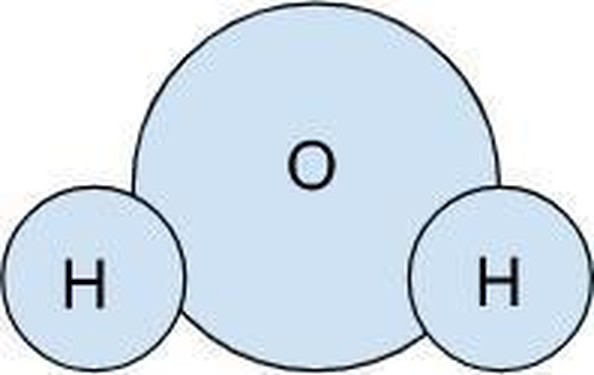
Two hydrogen atoms joined to one larger oxygen atom, drawn as overlapping circles labelled H, O and H.
Figure 1 | Article page 62Full size

Figure 01

A water molecule as a synthesis

Hydrogen and oxygen are distinct atoms with different properties, yet together they form a water molecule whose properties are not a simple sum of its parts. The paper uses this familiar example to introduce its central idea: distinct or opposing parts can form a new, unified whole, which dialectics calls a synthesis.

Caption in the paper

Illustration of the dialectical relationship in a water molecule.
Section 1.4 Dialectics in scienceRead it on page 62
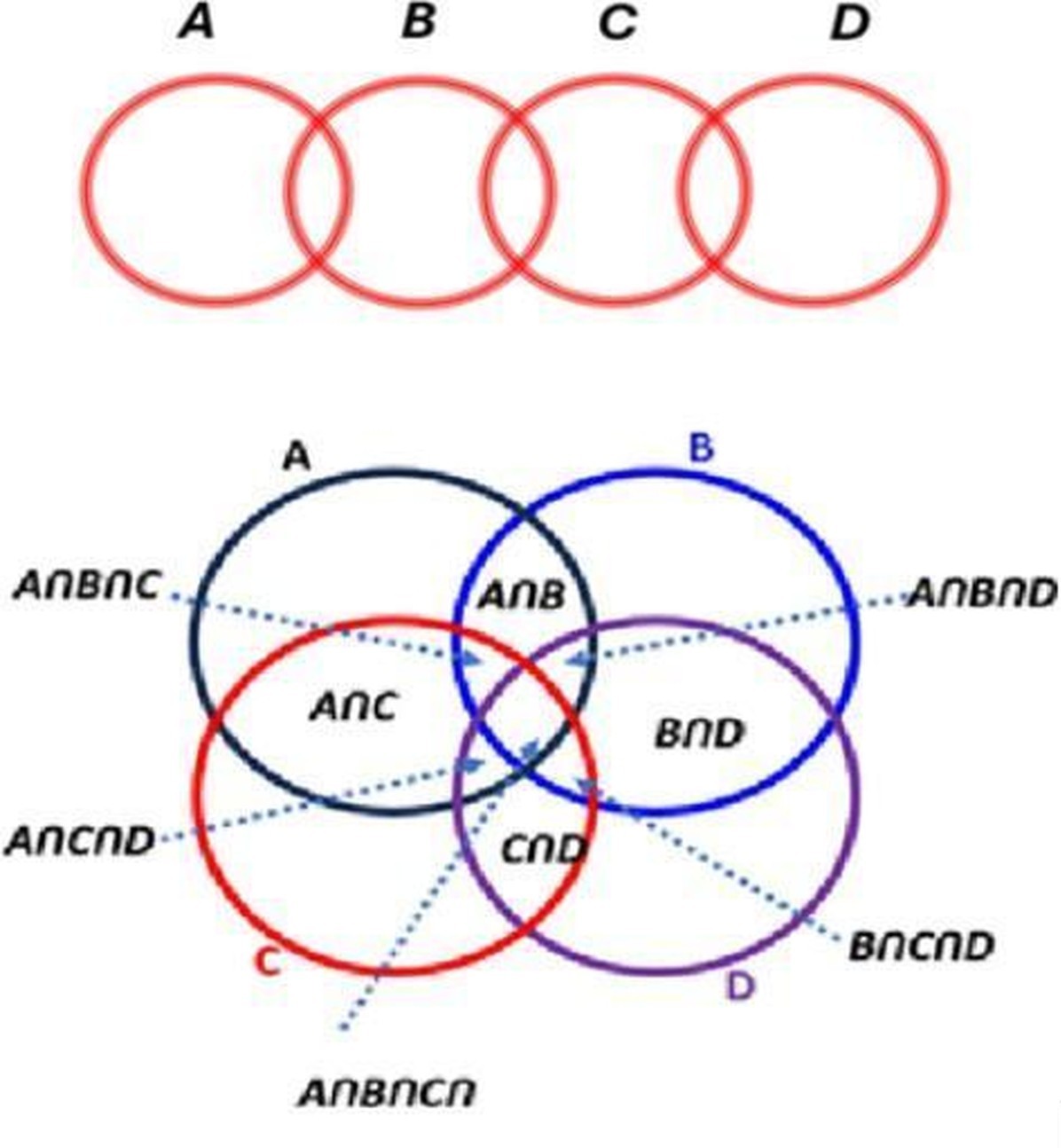
Top: four circles labelled A, B, C and D in a row, each overlapping its neighbour. Bottom: the four circles overlapping in a cluster, with every intersection labelled, such as A∩B and A∩B∩C.
Figure 2 | Article page 64Full size

Figure 02

Four quantum states, apart and together

Each circle stands for a distinct quantum state, A, B, C or D. The lower diagram overlaps all four and labels every intersection, showing that quantum mechanics also lets these distinct states combine into one coherent superposition. The paper reads this as two complementary descriptions of one system, separate states and a unified whole, with a single definite outcome appearing only when a measurement is made.

Caption in the paper

Representation of different quantum states A, B, C, and D, including their intersections and unification.

Section 2.1 A dialectical interpretationRead it on page 64
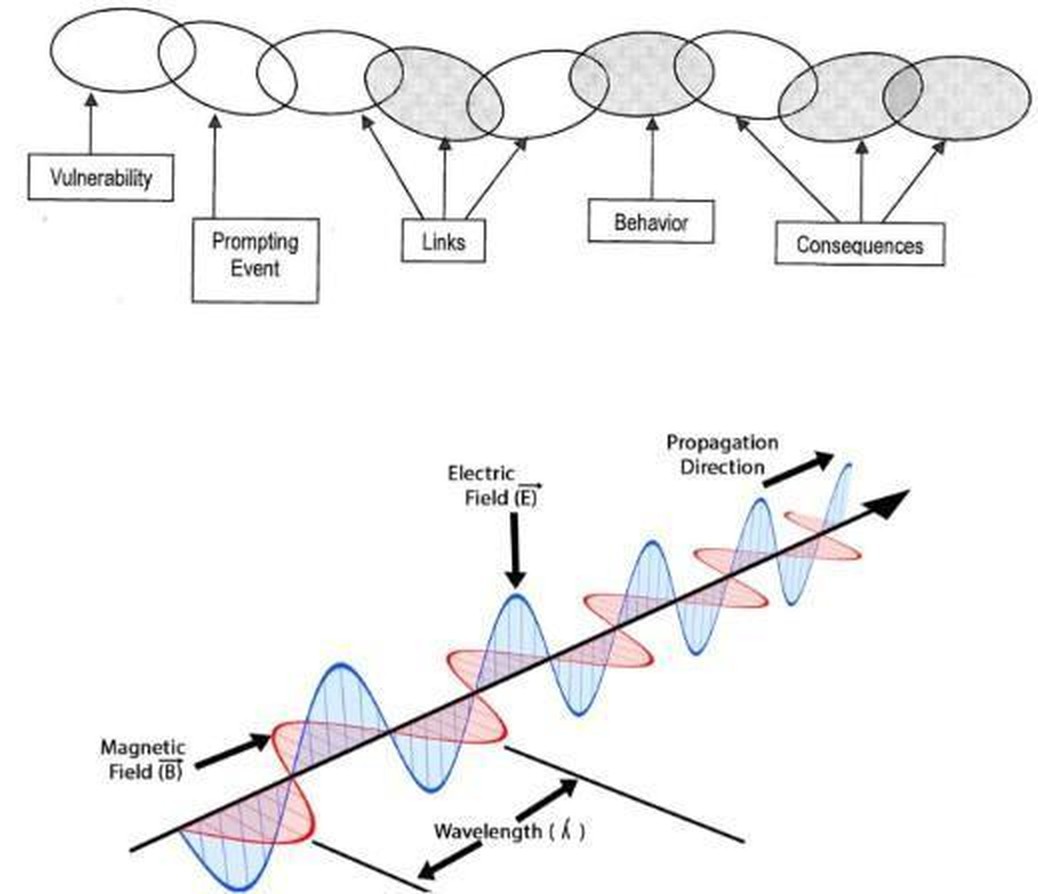
Top: a chain of linked ovals labelled vulnerability, prompting event, links, behavior and consequences. Bottom: an electromagnetic wave with perpendicular electric and magnetic fields along a propagation direction.
Figure 3 | Article page 66Full size

Figure 03

Chains of change: behaviour and waves

The top row is a chain analysis, a tool from behavioural science in which each event shapes the next: vulnerability, prompting event, links, behaviour and consequences. The lower panel shows an electromagnetic wave, where changing electric and magnetic fields continually generate each other. The paper places them side by side as an analogy: in both, change unfolds through linked, coupled steps rather than isolated events.

Caption in the paper

Illustration of the relationship between quantum states and dialectics. The chain analysis (top) of vulnerability-prompting events links behavior and consequences, demonstrating how change occurs over time. The lower panel shows electromagnetic wave propagation, where oscillating electric and magnetic fields illustrate continuous, coupled evolution in time and space.

Section 2.2 Electromagnetic waves and dialecticsRead it on page 66
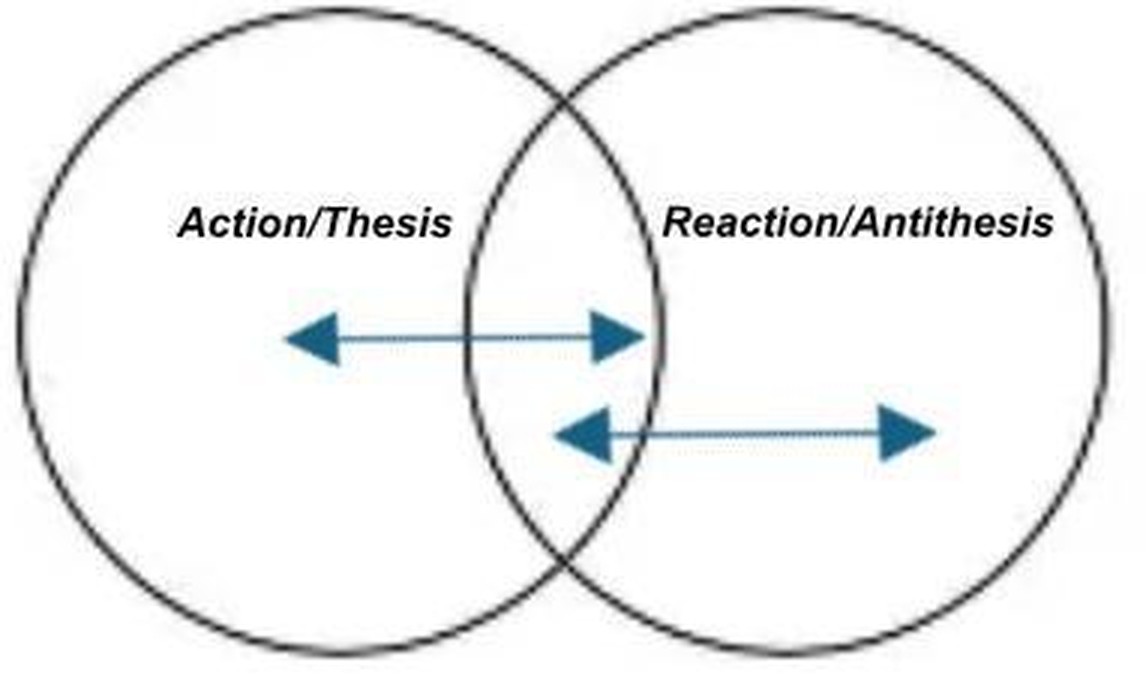
Two overlapping circles labelled Action/Thesis and Reaction/Antithesis, with double-headed arrows crossing the overlap.
Figure 4 | Article page 69Full size

Figure 04

Action and reaction as one interaction

Newton's third law says every action has an equal and opposite reaction, and that both forces belong to one interaction. Here action (the thesis) and reaction (the antithesis) are overlapping circles, and their overlap is the synthesis where the two meet. The paper uses this to argue that opposing states depend on each other, which it relates to quantum entanglement.

Caption in the paper

The synthesis of opposing states (action/thesis, reaction/antithesis) illustrates how opposing states are actually part of one single interaction and neither exists without the other.

Section 2.3 Newton's third law of motion and dialecticsRead it on page 69
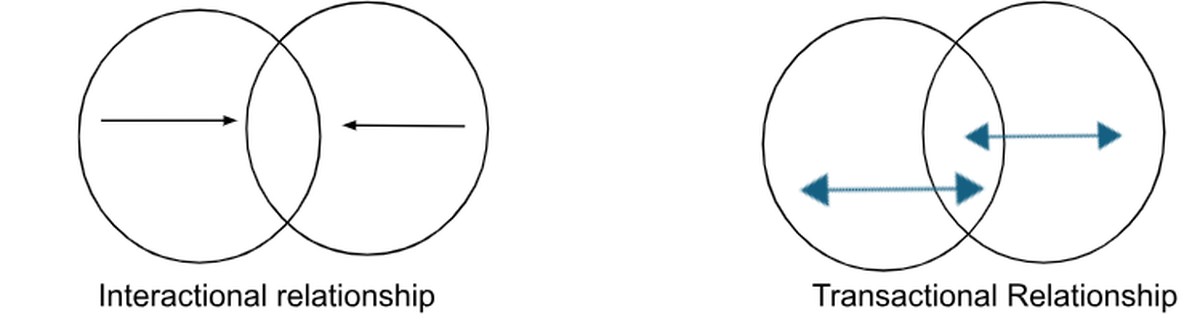
Left: two overlapping circles with single arrows pointing toward each other, labelled interactional relationship. Right: two overlapping circles with double-headed arrows, labelled transactional relationship.
Figure 5 | Article page 69Full size

Figure 05

Interactional and transactional relationships

On the left is an interactional relationship: two sides take turns, one sending while the other responds. On the right is a transactional relationship: each side sends and receives at the same time, and both are changed by the exchange. The paper argues that Newton's laws describe the first kind, while dialectics describes the second.

Caption in the paper

Plot of interactional and transactional relationships.

Section 2.3 Newton's third law of motion and dialecticsRead it on page 69
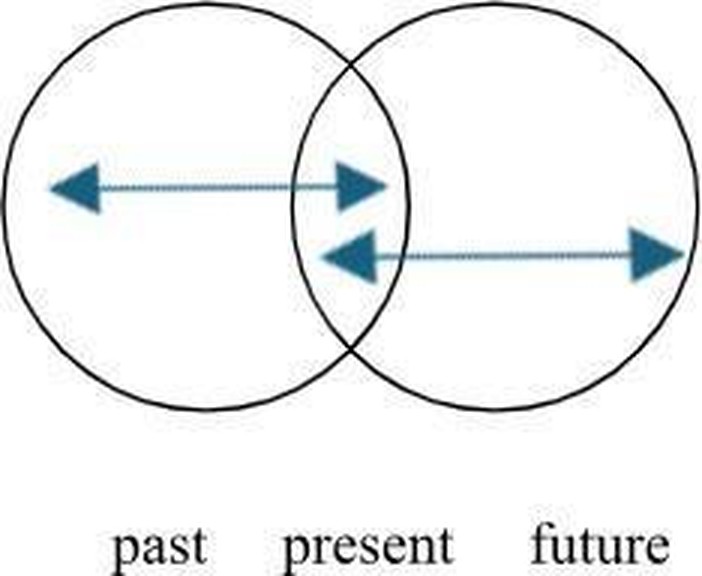
Two overlapping circles with double-headed arrows, labelled past, present and future from left to right.
Figure 6 | Article page 70Full size

Figure 06

Past, present and future

Past and future are drawn as two overlapping circles, with the present at their overlap. The paper interprets time as a continuous, two-way relationship: the present is where past and future meet, and each new present becomes the next past and future. It connects this to research suggesting that, at the quantum level, time may not run in only one direction.

Caption in the paper

A dialectical interpretation of time.

Section 2.3 Newton's third law of motion and dialecticsRead it on page 70

02

Figures 7 to 10

Matter, energy, time, space and forces

The last four figures apply the same reasoning to the building blocks of physics and to the question of unifying quantum physics with relativity.

Article pages 83-89
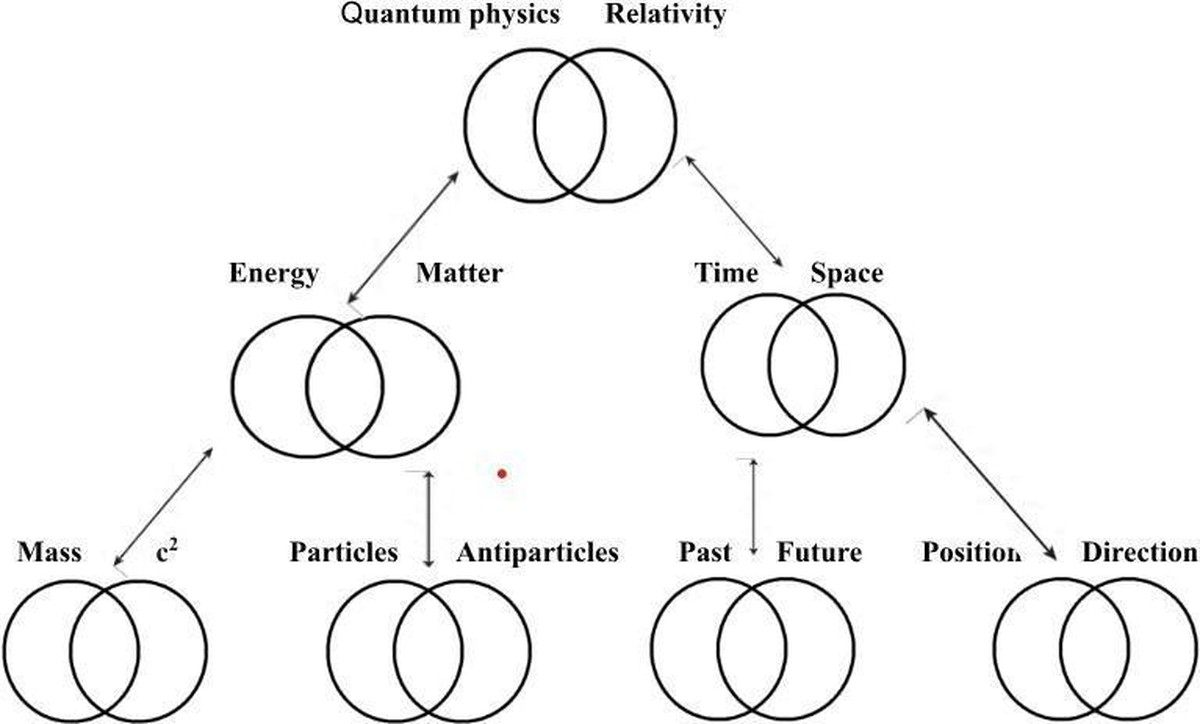
A three-level tree of overlapping circle pairs: mass and c squared, particles and antiparticles, past and future, position and direction at the bottom; energy and matter, time and space in the middle; quantum physics and relativity at the top.
Figure 7 | Article page 83Full size

Figure 07

Matter, energy, time and space

A tree of pairings. At the bottom, mass and the speed of light combine into energy, particles and antiparticles into matter, past and future into time, and position and direction into space. Energy and matter then pair as quantum physics, and time and space as relativity. The paper presents this as one interdependent system in which each part is defined by its relation to the others.

Caption in the paper

A dialectical interpretation of matter, energy, time, and space.

Section 5.1 A dialectical interpretation of matter, energy, time, and spaceRead it on page 83
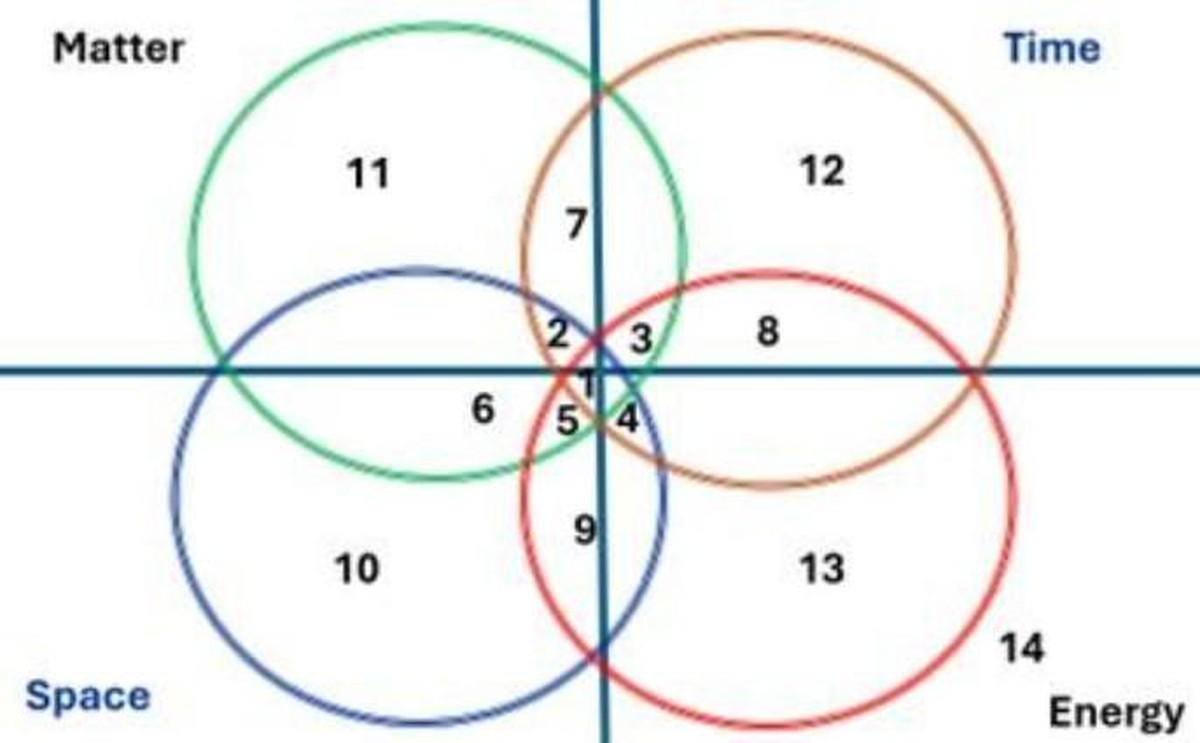
Four overlapping coloured circles labelled Matter, Time, Space and Energy, with regions numbered 1 to 14.
Figure 8 | Article page 86Full size

Figure 08

Every combination of the four

Matter, energy, time and space are drawn as four overlapping sets. The numbered regions mark the combinations: all four at once (1), groups of three (2 to 5), pairs (6 to 9) and each on its own (10 to 13), with the caption labelling region 14 as a superposition of states. The paper draws on set theory here to map the possible relationships between the four.

Caption in the paper

(1) all possible states at once (2) space, matter, and time (3) matter, time, and energy (4) space, time, and energy (5) matter, energy, and space (6) space and matter (7) matter and time (8) time and energy (9) space and energy (10) space (11) matter (12) time (13) energy (14) superposition of states.

Section 5.2 Unification problem between quantum mechanics and relativityRead it on page 86
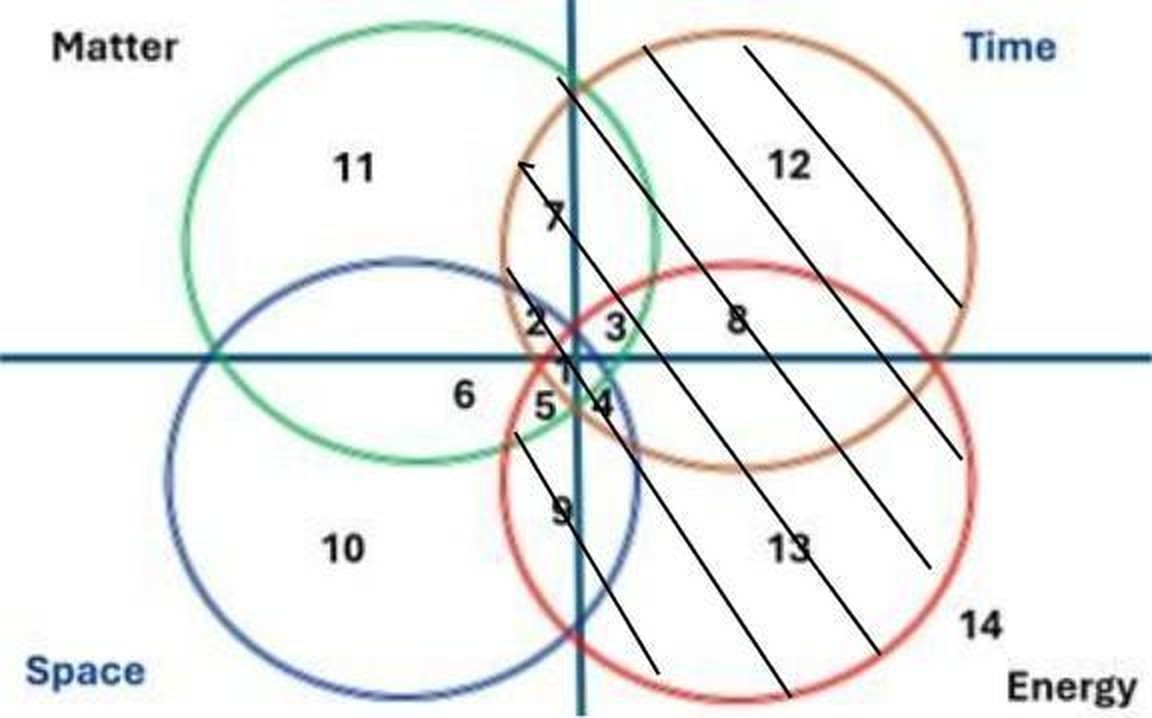
The four-circle diagram of matter, time, space and energy, with diagonal hatching over the time and energy circles.
Figure 9 | Article page 88Full size

Figure 09

The states linked by speed

The same diagram, with shading over the regions that contain energy or time. The paper proposes that speed is the trait shared by quantum physics, through energy, and relativity, through time, and that reality forms from the states containing speed: regions 1, 2, 3, 4, 5, 7, 8, 9, 12 and 13. Turning this into a formal mathematical description is listed as future work.

Caption in the paper

A dialectical interpretation of matter, energy, time, and space: the synthesis of all possible states that contain the common, interlocking trait of speed.

Section 5.3 Algebraic description of the dialectics of quantum systems and relativityRead it on page 88
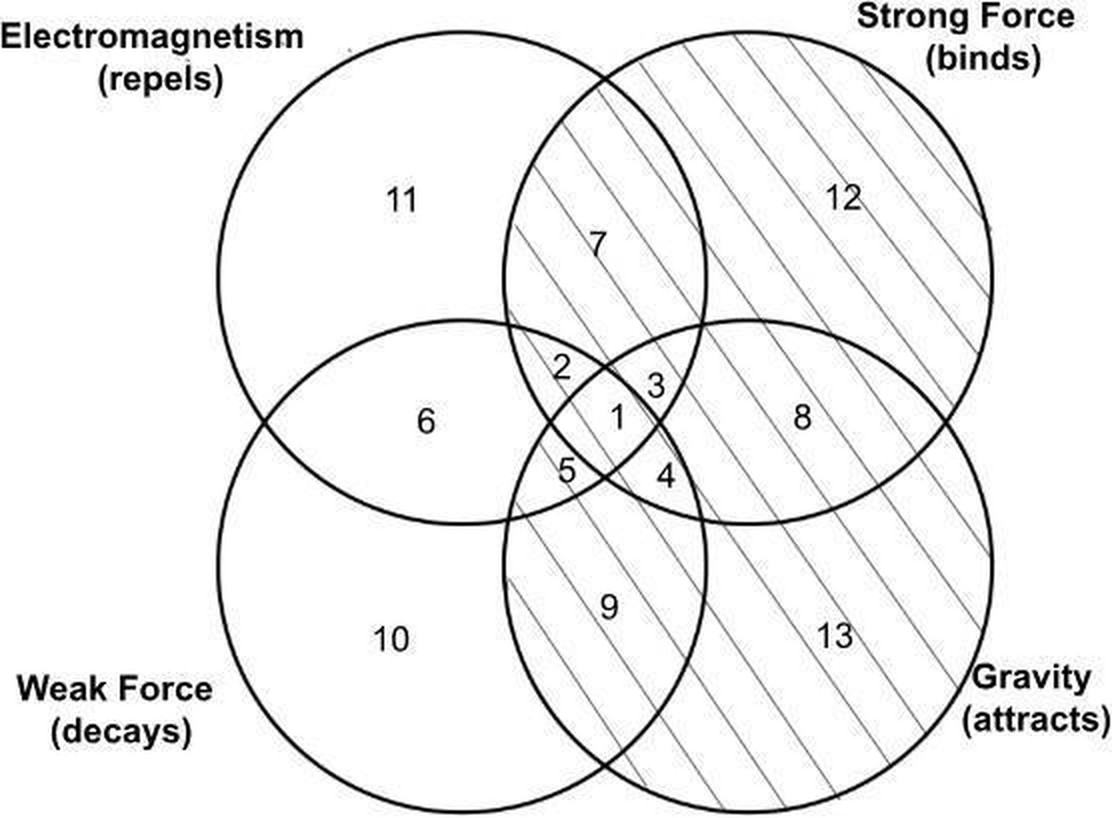
Four overlapping circles labelled electromagnetism (repels), strong force (binds), weak force (decays) and gravity (attracts), with numbered regions and hatching over the strong force and gravity circles.
Figure 10 | Article page 89Full size

Figure 10

The four fundamental forces

The four fundamental forces in the same four-circle pattern: electromagnetism (repels), the strong force (binds), the weak force (decays) and gravity (attracts). Shading marks the states that share the traits of attracting and binding. The paper notes that this layout matches its diagram for matter, energy, time and space, and names a mathematical formula for it as a goal for future research.

Caption in the paper

A dialectical interpretation of the fundamental forces.

Section 5.4 A dialectical interpretation of the fundamental forcesRead it on page 89
Source

Klein, T., & Igumbor, E. (2026). Toward a unified framework of physics: Insights from dialectics, quantum theory, and relativity. International Journal of Quantum Foundations, 12(3), 55-98.

Continue with the source

See each figure in the context of the full argument.

Open the publication reader