Part 1
The brief
The question
Quantum mechanics predicts experimental results with extraordinary precision, yet it leaves open how a superposition of possible outcomes becomes the single result recorded in a measurement. A second open question sits beside it: how quantum theory relates to the spacetime description of relativity. This paper approaches both through a single idea, the relationship between parts and wholes.
The idea
Dialectics describes how opposing or complementary elements gain their meaning through their relationship within a larger whole. Applied to physics, a single quantum state is a part and the superposition is the whole. Before measurement, the superposition describes the system without a specific spacetime reference. Measurement places the system in one concrete context, a particular place, time, apparatus and environment, and a definite outcome emerges from that context. The framework works alongside standard quantum mechanics rather than replacing it, and it proposes speed, common to quantum motion and to relativity, as a conceptual link between the two theories.
Where the work stands
The framework is at a foundational stage. Its consistency with the established structure of quantum theory and relativity, and its potential to address gaps in the research literature, are encouraging early signs that further study could expand our understanding of quantum measurement, entanglement, superposition, and the relationship between quantum physics and relativity. The open tasks are to give the dialectical relationship a precise mathematical form, to show that this form recovers the Born rule, unitary evolution and relativistic causality, and to find whether it predicts any measurable differences from decoherence or existing collapse models.
Why we are sharing this
We believe the significance of these findings warrants further research. Our aim is to bring them to the attention of researchers in quantum foundations, quantum measurement and decoherence; of those working on relativity, unification and physics beyond the Standard Model; and of mathematical physicists. These are the researchers best placed to give the framework a mathematical form, compare it with relational and collapse approaches, or identify possible experimental tests.
Part 2
Research Overview
The research examines the complementary relationship between quantum states and how complementary quantum states may be understood as interdependent components of a single unified system. The study emphasizes that the behavior of a system evolves through interacting states that exhibit both opposition and complementarity. Like atoms within a molecule, quantum states exist as separate constituents while simultaneously forming a unified structure, so the system cannot be fully described as a simple sum of independent parts and instead requires a holistic state description. For instance, particles and antiparticles are two distinct, opposing parts that also exhibit complementarity, together forming one greater, whole structure of matter. Likewise, mass (an object’s resistance to motion) and the speed of light squared, c² (a state of motion), are two distinct, opposing parts that together form one greater, whole structure of energy.
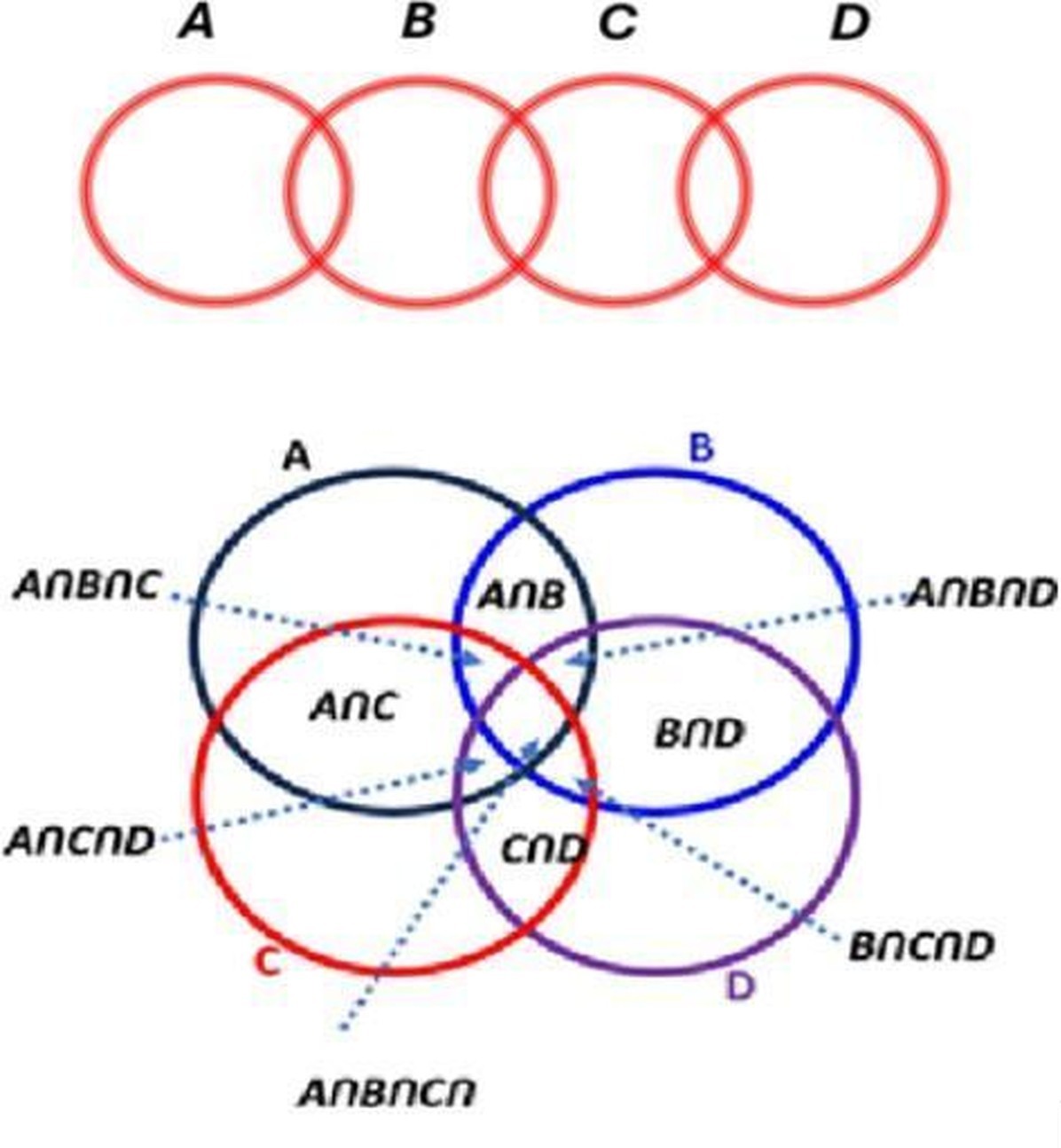
A dialectical interpretation summarizes the structure in Figure 1 as follows: (i) basis quantum states are distinct and orthogonal yet contribute toward a unified quantum state; (ii) the system is described by a coherent superposition rather than a classical mixture; (iii) apparent incompatibility arises from measurement context rather than intrinsic contradiction; and (iv) measurement produces a definite outcome from an underlying non-classical continuum.
Measurement
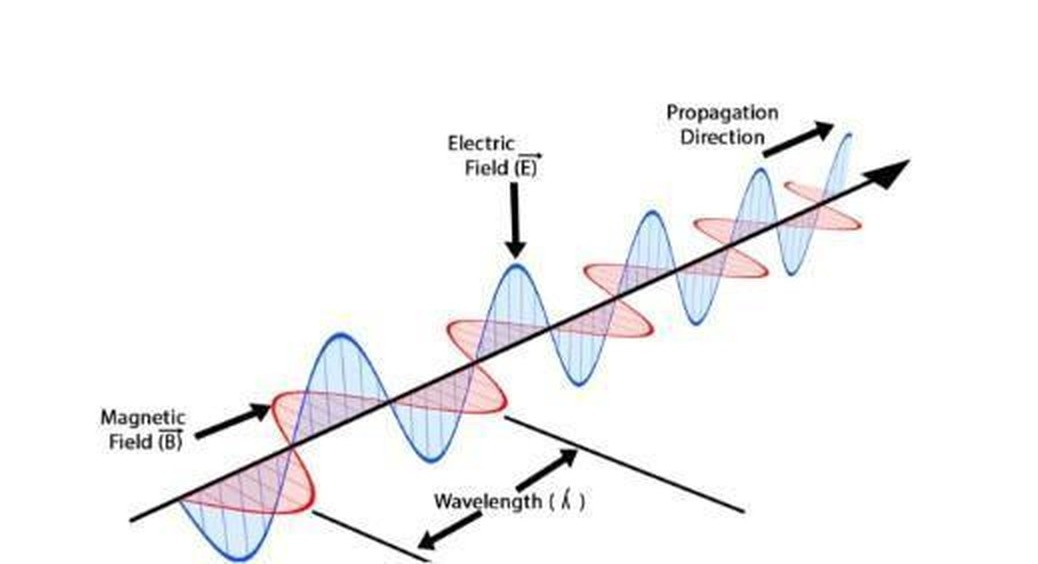
Applying dialectics to measurement in quantum mechanics, Figure 2 illustrates how a wave comprises: (i) two opposing and complementary states, crest and trough, which simultaneously oppose each other and synthesize together; (ii) each crest and trough exists separately while also forming part of one continuous, interconnected system; (iii) although crest and trough are incompatible with each other, they share a continuous, transactional relationship; (iv) the tension between each crest and trough is resolved through a synthesis, creating one continuum of equal magnitude and opposite direction that connects the two opposing states while driving motion and change in the system; (v) the new state following change, the synthesis, also consists of opposing parts (a new crest and trough), and thus change is continuous; (vi) each crest and trough exists relative to its interaction with each other part and relative to the system as a whole; and (vii) crest and trough are two parts of a single interaction, and neither exists without the other.
Entanglement
When we focus on one point in the wave, we observe a single quantum state. When we view the wave as one whole continuum, we observe one unified system or superposition of states. Moving back and forth between the part and the whole shows how a quantum state and a superposition of states exist simultaneously; only the perspective changes. Each quantum state is a part of one whole continuum or superposition of states. Each quantum state or part exists and evolves relative to its interaction with each other quantum state or part and relative to the system as a whole. The framework postulates that this interdependence captures the essence of quantum entanglement.
Particle classification
A dialectical reading can also be applied to structural classifications in particle physics. Bosons and fermions oppose each other in exchange symmetry: boson states are symmetric and fermion states are antisymmetric. Despite this opposition, both classes are unified within the spin–statistics theorem, which links intrinsic spin to statistical behavior in relativistic quantum field theory. In this way, bosons and fermions can also be read as complementary structures or parts whose interaction becomes richer in reduced dimensionality, giving rise to intermediate statistical phases such as anyons while forming one whole continuum of change.
Relativity and time
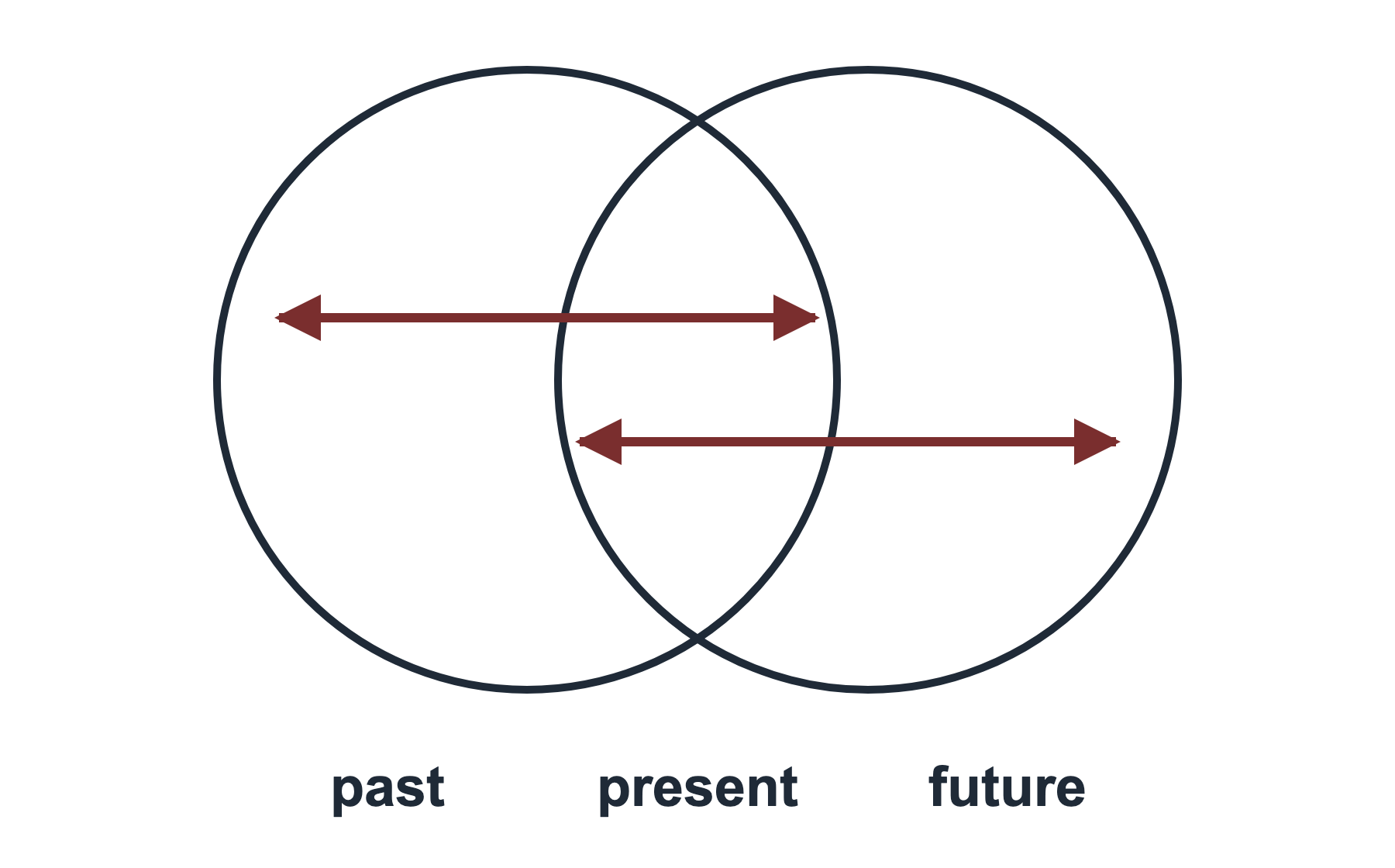
Applying dialectics to relativity, time and space are two opposing and complementary parts whose interaction and synthesis create one whole continuum of spacetime. Past and future can similarly be seen as two opposing and complementary parts whose interaction and synthesis create the present, as well as one whole continuum of time. In this way, past and future are two opposing and complementary parts of a single interaction, and neither exists without the other. This offers a way of interpreting recent research suggesting that time may flow in two directions (Figure 3).
Observation and spacetime context
From a dialectical perspective, a quantum state in superposition exists independently of any particular spacetime reference; it is a spacetime reference that separates one state from another. Once relativity is introduced into the system, that is, once the wave’s state is taken at a specific point in time and space, as happens when an observation or measurement is made, one of the many possible states becomes definite and measurable. In this way, the framework interprets observation as the selection of a particular spacetime context within one interconnected continuum of potential states.
Dialectics also provides a framework for thinking about observer effects and reality, in which opposing objective and subjective states also share a complementary relationship. For instance, if a tree falls in a forest and no one is around to hear it, the synthesis of the objective and subjective states is: “A tree falls in the forest, and no one is around to hear the sound of the fall.” In this way, complementary objective and subjective states synthesize together to create one greater, whole truth or state of reality. Objective and subjective reality are two opposing and complementary parts of a single interaction.
Part 3
Recommendations for Further Research
1. Matter, energy, time and space as one system
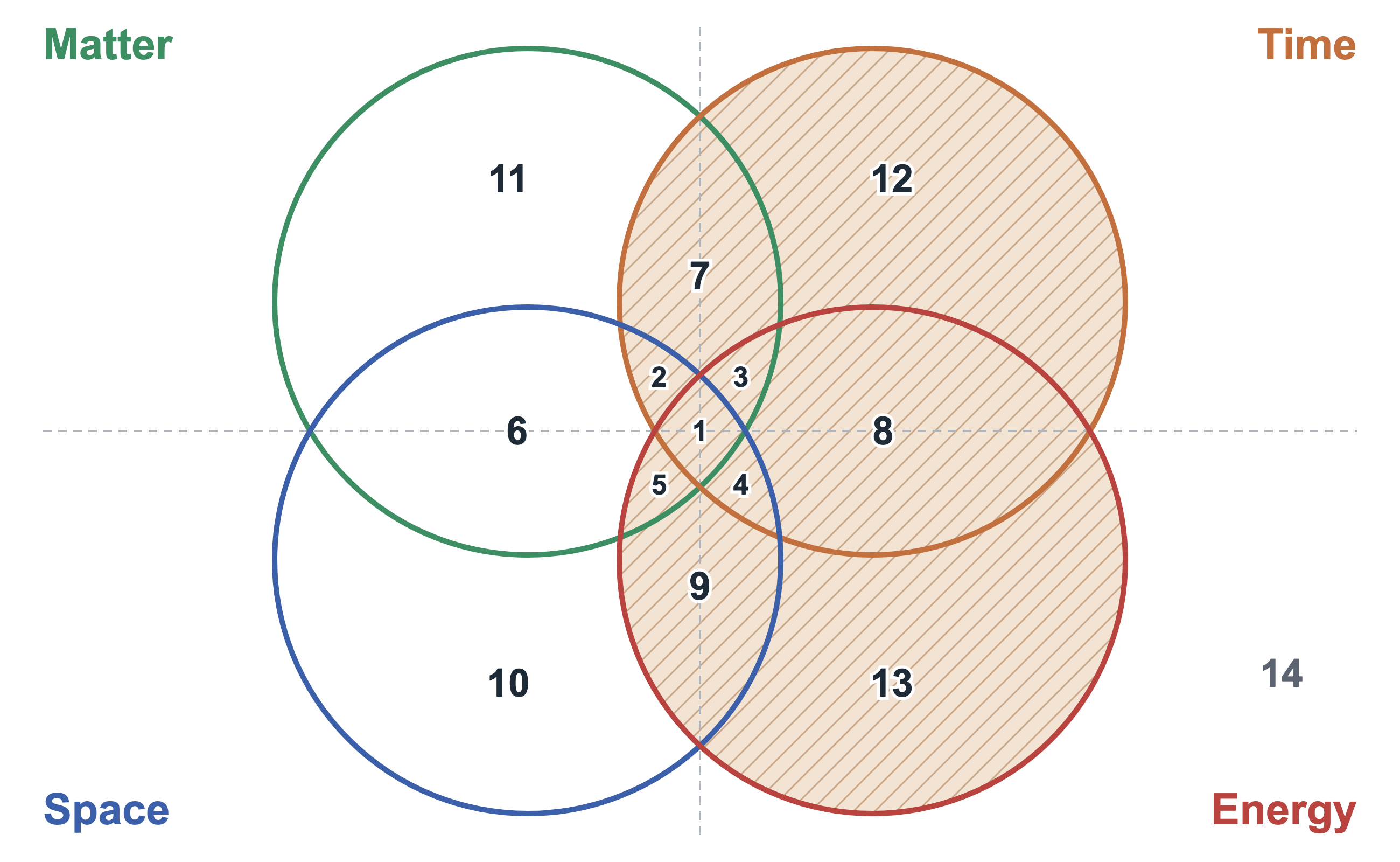
Applying dialectics to quantum physics offers a new way of looking at its relationship with relativity, suggesting that the two share both opposition and complementarity. A dialectical interpretation of matter, energy, time and space is illustrated in Figure 4.
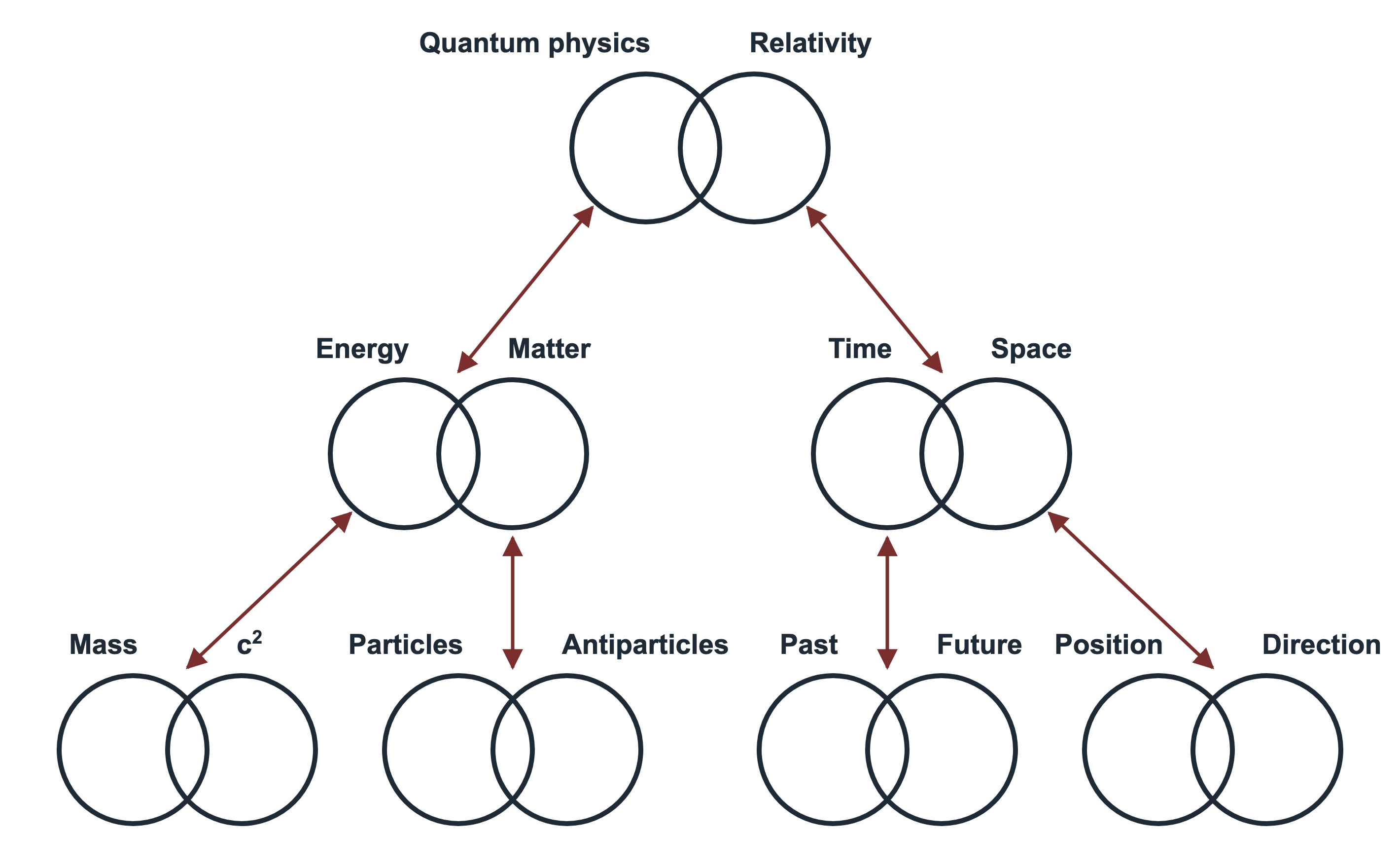
Figure 4 illustrates how separate, opposing parts of nature can simultaneously share complementary relationships, forming a single interaction within one interdependent continuum in constant motion and change. Each part of the system exists and evolves relative to its interaction with each other part and relative to the system as a whole. The framework offers this as a dialectical illustration of entanglement.
2. Speed as the link between quantum physics and relativity
A dialectical framework also offers a closer look at the relationship between quantum physics and relativity, as illustrated in Figure 5. The framework proposes speed as the common trait that links the two. As matter, energy, time and space come together, they create thirteen possible states, ten of which share the common, interlocking trait of speed. According to dialectical principles, the conflict between quantum physics and relativity may be resolved through a synthesis of the states that contain speed. Excluding states 6, 10 and 11, the states of matter and space alone, sets aside the very small particles of matter and the very large gravitational fields of space, creating a conceptual bridge between quantum physics and relativity.
3. The fundamental forces
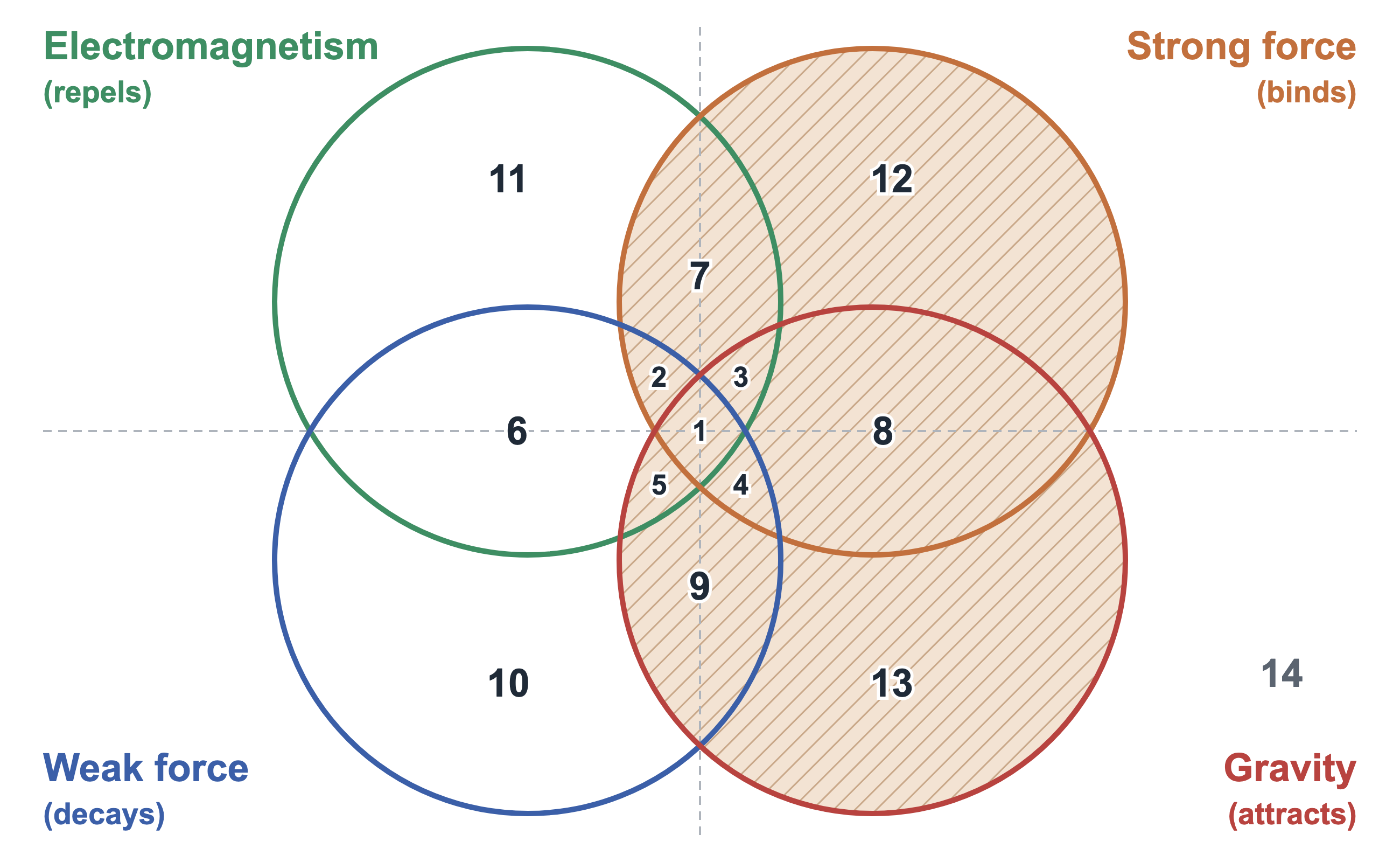
A dialectical framework can also be applied to the fundamental interactions of nature by examining their complementary relationships, as illustrated in Figure 6. In this reading, electromagnetic and weak interactions are two opposing parts that combine into a single interaction, the electroweak interaction. Time and space are opposing parts that together form the continuum in which gravity acts. Electric and magnetic fields are opposing parts that together form electromagnetism. The strong interaction (which binds) and the weak interaction (which decays) are opposing parts of nuclear interaction as a whole. Fermions and antifermions are opposing parts that take part in a single weak interaction. Quarks (which have mass) and gluons (which are massless) are opposing parts that together make up the strong interaction. Gravity (which attracts) and electromagnetism (which also repels) are opposing parts of one greater system.
As the four fundamental forces come together, Figure 6 shows a synthesis of the states that share the common, interlocking traits of attracting and binding. Dialectically, the forces create distinct new states that resolve the tension between them through a synthesis: the conflict between a thesis that attracts and binds, and an antithesis that repels and decays, is reconciled through their common traits, forming a new thesis that begins the process again.
Looking ahead
A second part of this research, a continuation of the work presented here, is currently in development and offers an opportunity for collaboration. Further details may be shared with researchers who are interested in taking part.